Run one guided wall sweep
Move steadily left to right while the app samples magnetic strength along a normalized wall path.
Two passes turn a fleeting peak into comparable evidence
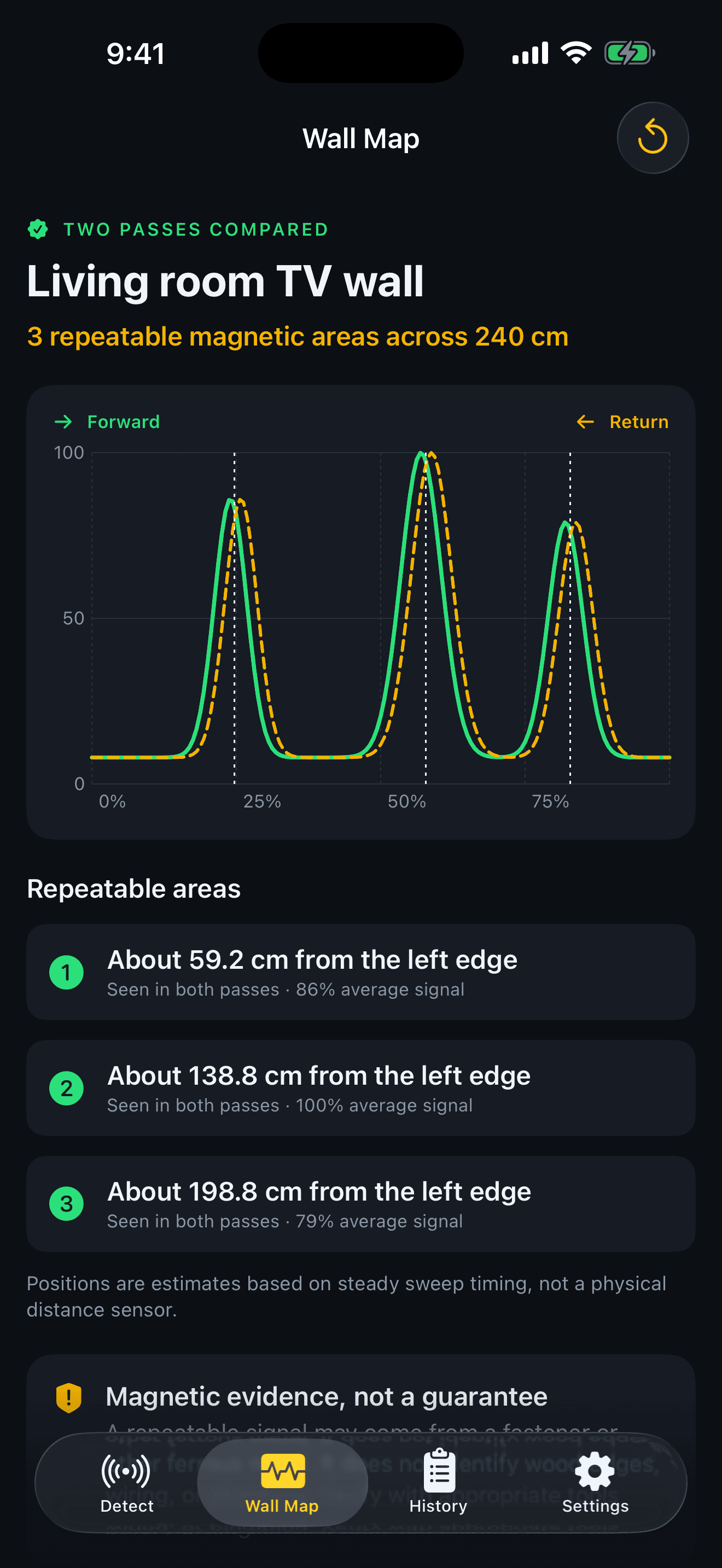
Follow one guided pass across the wall, return over the same path, and compare magnetic peaks that repeat near the same estimated position.
Built for the task
Run one guided wall sweep
The short answer
A direct definition for readers, search engines, and answer systems.
Stud Finder is an iPhone magnetometer utility that compares forward and return sweeps over one wall section. Its Wall Map highlights magnetic peaks that repeat at similar time-normalized positions. Those peaks can be clues from nearby ferrous screws or nails, but they do not prove wood, exact distance, wiring, pipes, cavities, or safe drilling points.
The app detects magnetic-field changes, not wood edges, wiring, plumbing, gas lines, or cavities. Always confirm with appropriate tools and safe work practices before drilling or cutting.
Inside the app
Every feature supports the same workflow, so the app feels like a system rather than a folder of disconnected AI buttons.
Move steadily left to right while the app samples magnetic strength along a normalized wall path.
Return across the same area so one transient reading is not mistaken for repeatable evidence.
Review forward and return curves plus the magnetic areas that appeared near the same estimated position.
Open Detect for a calibrated strength meter when a complete two-pass map is unnecessary.
Label the wall section, keep the map locally, or share a plain-text evidence summary.
The app never labels a signal as wood, wiring, a pipe, a measured distance, or a safe place to drill.
Product tour
Real screens from the current iPhone experience.


How it works
Remove magnetic accessories and nearby interference, then calibrate with the phone held in a consistent orientation.
Sweep left to right at a steady pace, then return across the same path without changing the phone orientation.
Compare the curves and estimated positions, then verify every possible fastener clue with appropriate tools before drilling.
Who it helps
Practical guide
Combine visible construction information, repeatable magnetic fastener clues, and appropriate dedicated tools without treating one phone reading as proof of wood, a drilling coordinate, or a cleared wall.
Direct answers
No. The iPhone magnetometer responds to nearby magnetic-field changes, often from ferrous-metal screws or nails. A peak may be a clue associated with a stud, not proof of the wood’s location or edges.
No. It cannot reliably detect or rule out electrical wiring, plumbing, gas lines, or other hidden hazards. Use appropriate dedicated tools and safe work practices before drilling.
Magnetic cases, mounts, nearby electronics, speakers, and metal objects can distort the magnetometer. Remove magnetic accessories and recalibrate away from interference.
It compares magnetic strength over elapsed time during two guided passes. Positions are normalized estimates along the sweep, not centimetres, inches, depth, or a physical map of the wall.
Wall Maps and scan notes stay locally in the app’s private container on the iPhone. No account is required.
Preparing for the App Store
The release package is being prepared and the public App Store page will appear after launch.
Coming soon