01
Link particles and symbols
For each equation, name the species, sketch the particle-level change, state what the arrow means, and connect coefficients to relative amounts rather than treating the symbols as decoration.
Practical guide
Chemistry becomes usable when the particles, symbols, quantities, and observations describe the same process. Learn one concept boundary, translate between representations, solve a representative problem from a blank page, check the chemistry and units, then retrieve the method again after a delay.
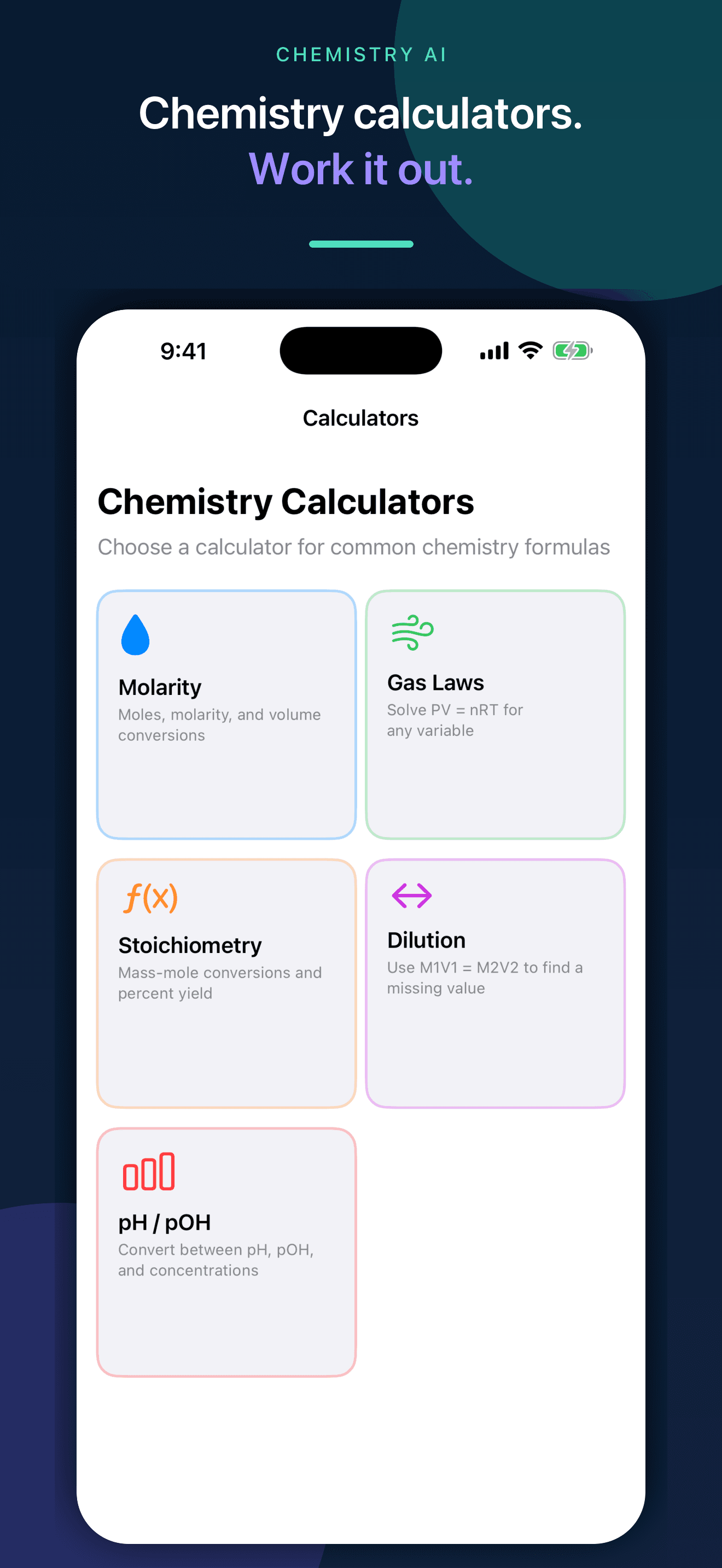
Available on iPhone · Photo problems, worked reasoning, five calculators, quizzes, flashcards, and references
What to look for
A formula is only useful when you know what its variables mean, when its assumptions hold, how the units connect, and what particle or reaction model sits underneath it.
For each equation, name the species, sketch the particle-level change, state what the arrow means, and connect coefficients to relative amounts rather than treating the symbols as decoration.
Write every given with its unit, identify the requested quantity, and build the conversion path before calculating. Keep coefficients, molar masses, concentration, pressure, temperature, and significant figures explicit.
Verify atom balance, charge balance, formula choice, unit consistency, conditions, assumptions, sign, magnitude, and significant figures against the original problem and course material.
Close the worked answer and reconstruct the setup from memory. Revisit the idea across multiple sessions and mix it with related problem types so the cues do not give the method away.
Step by step
Use the syllabus, assigned chapter, learning objectives, and instructor examples to set a narrow target such as balancing redox equations or calculating a limiting reactant. Do not let an app silently redefine the course scope.
Describe the observable change, draw or imagine the particles involved, and write the symbolic equation or relationship. Explain how the three representations correspond before moving to arithmetic.
List the givens and unknown, balance the equation when relevant, choose the relationship, show the unit path, substitute values, and state the result with units and appropriate significant figures.
Compare with the original prompt and a trusted course source. Check coefficients, charges, atoms, units, conditions, assumptions, signs, magnitude, rounding, and whether the answer addresses the actual question.
Rework the setup without notes, answer a short quiz, or teach the method aloud. Return after a delay and interleave a related problem so you must decide which principle applies instead of repeating one template.
Never use an AI-generated answer as authorization to mix, heat, taste, smell, dispose of, transport, or handle a substance. Follow the instructor, approved procedure, current safety data, labels, local rules, and laboratory supervision.
Inside the app
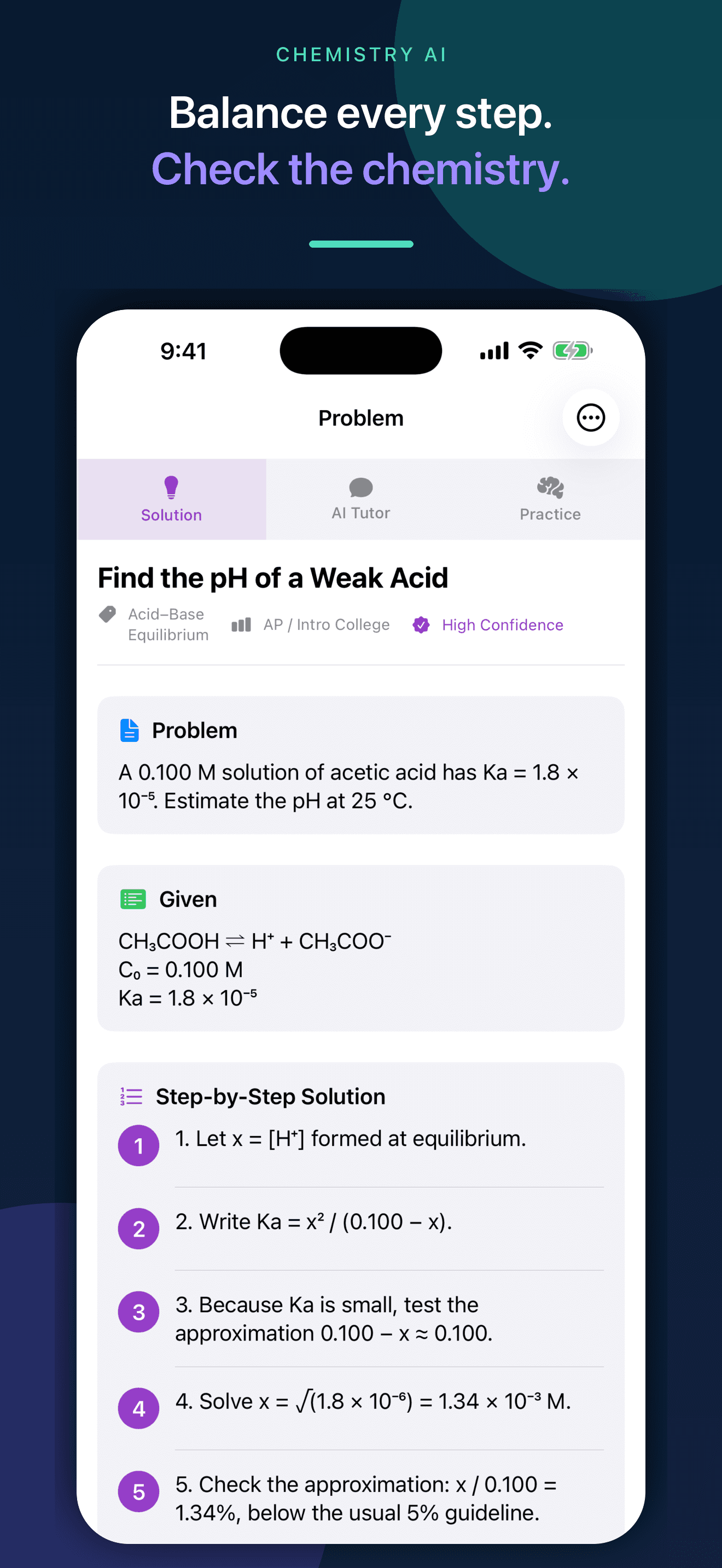
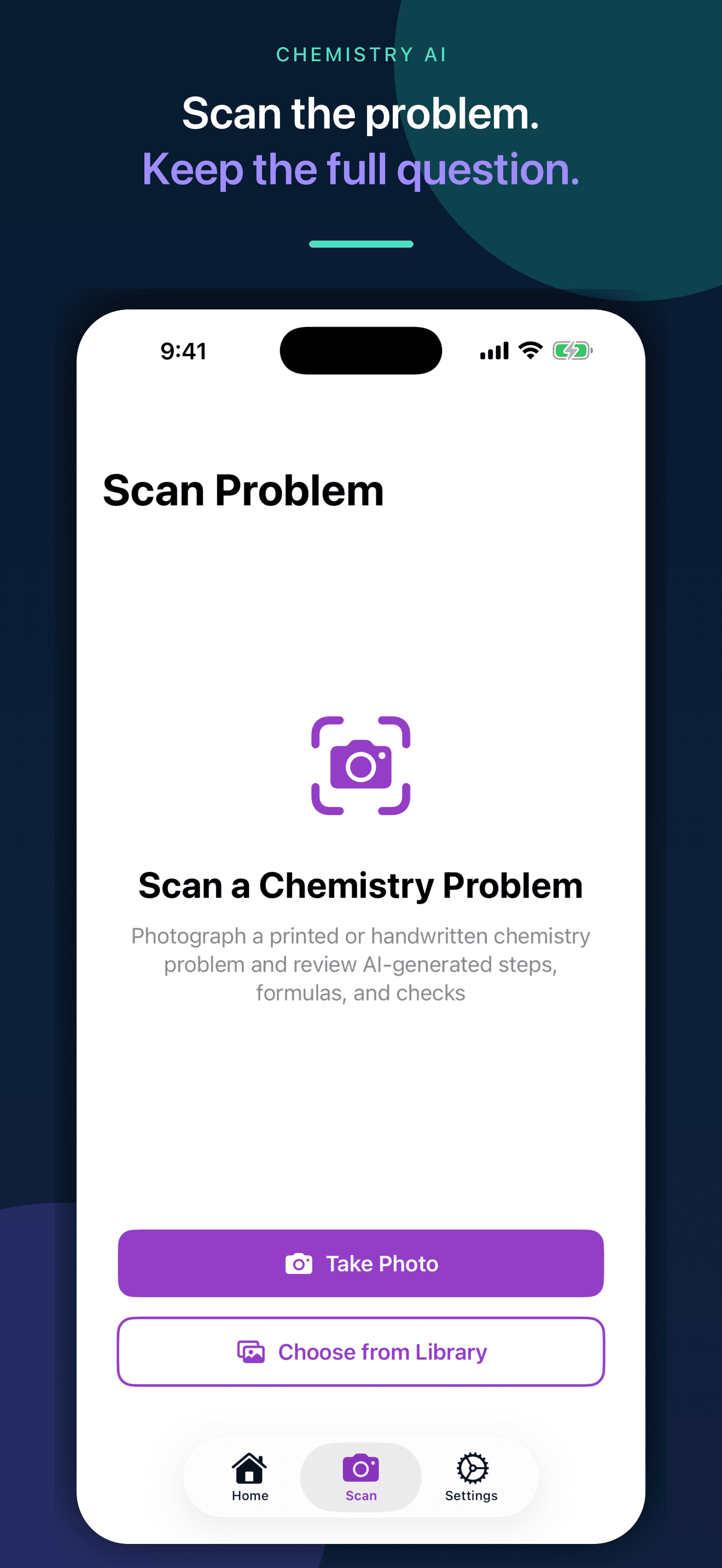
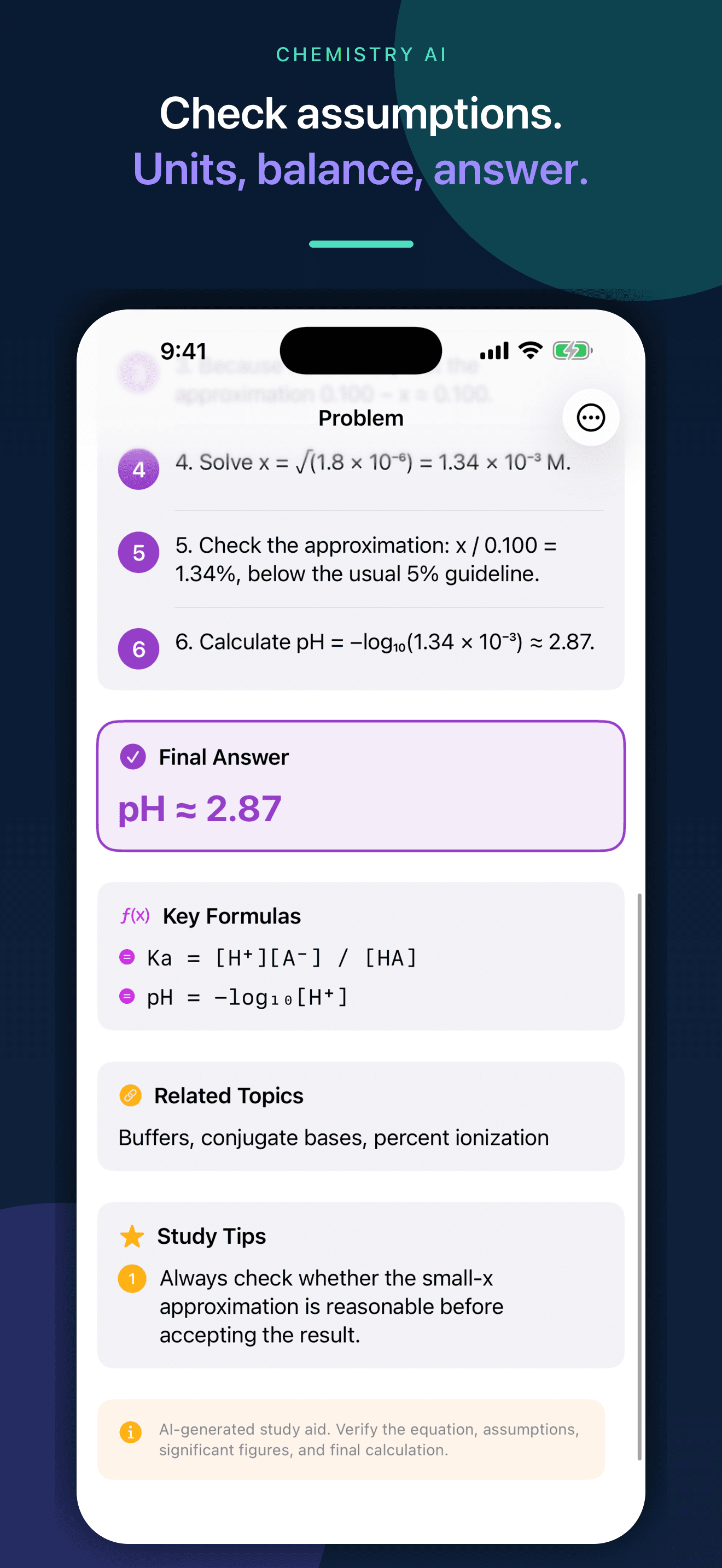
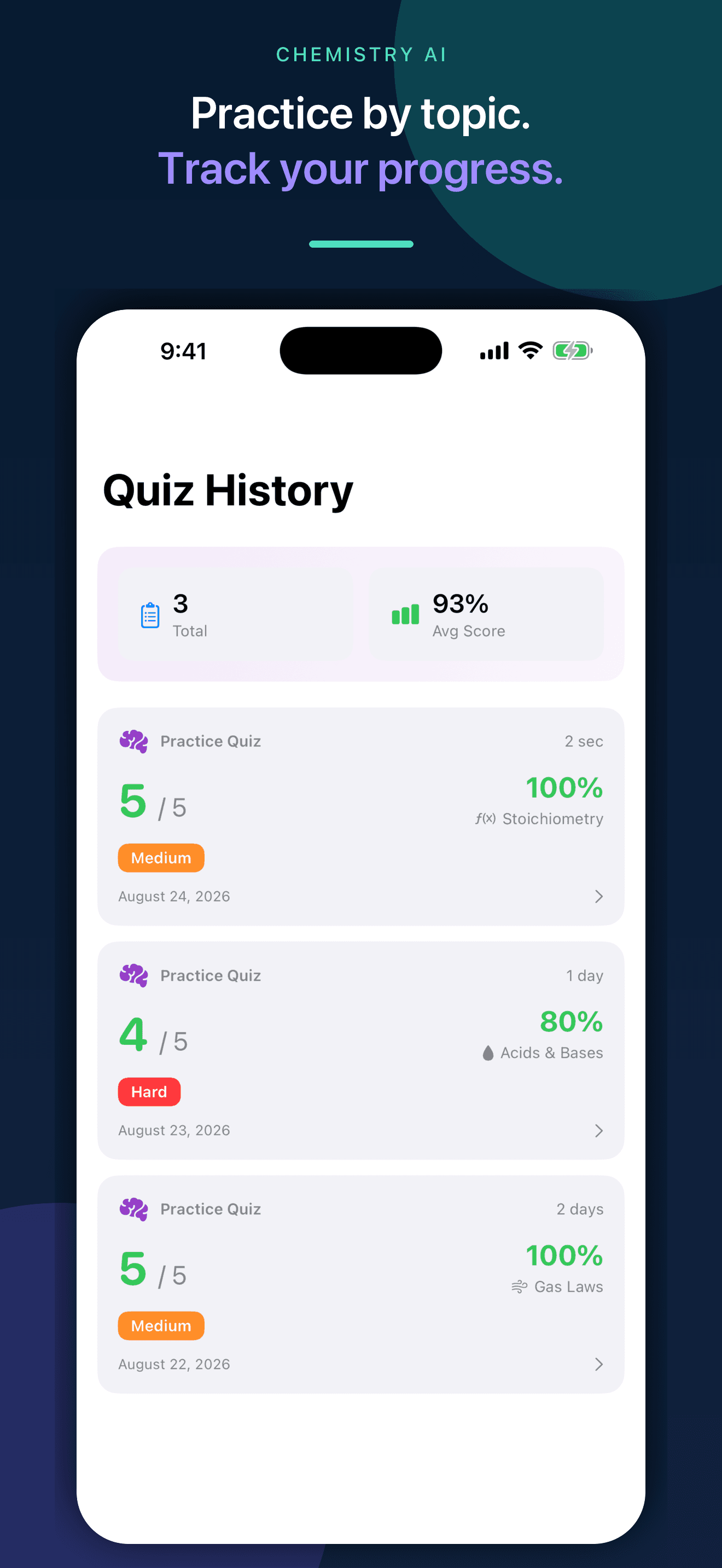
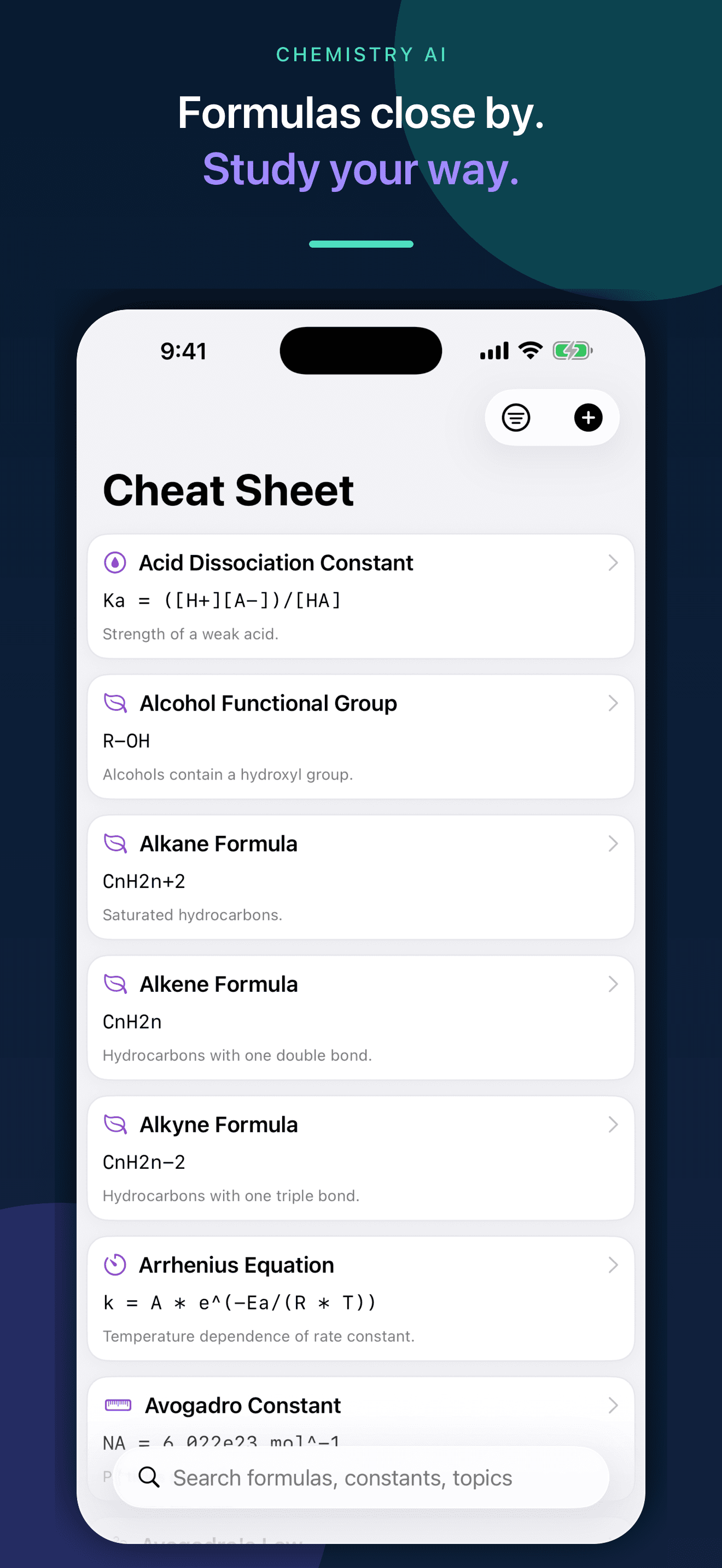
These are actual Chemistry AI screens using fictional DEBUG-only showcase data. The app can organize a possible solution, calculations, checks, quizzes, flashcards, and references. AI can still misread a symbol, charge, coefficient, condition, unit, or diagram and should never direct laboratory handling or safety decisions.
Try the app
Chemistry AI can analyze a selected problem, organize possible reasoning, provide follow-up explanations, and connect the result to calculators, quizzes, flashcards, and reference sheets. Rebuild the method yourself and verify important chemistry with the assigned source or instructor.
Learning and safety references
These learning-science, chemistry-education, reference, and laboratory-safety sources support the method and limits on this page. They do not endorse Chemistry AI.
Direct answers
Set one course-sized objective, connect the observable, particle, and symbolic representations, solve a representative problem from a blank page, run independent checks, retrieve the method without notes, and revisit it after a delay. Use the syllabus and assigned material to decide what matters.
Recall the formulas you need, but attach each one to its variables, units, assumptions, limiting cases, and a representative problem. Memorizing a symbol pattern without knowing when it applies is not enough for transfer to a new question.
Start with a correctly balanced equation, convert the known quantity to moles, use the coefficient ratio, then convert to the requested unit. Keep the unit path visible and check the limiting reactant, significant figures, and whether the result is physically plausible.
No. Spaced flashcards can support retrieval of terms, formulas, ions, and patterns, but pair them with equations, particle models, explanation, data interpretation, and mixed quantitative problems that require selecting the method.
No. AI can misread notation and generate plausible but incorrect equations, assumptions, or calculations. Use it to inspect a possible method or create practice, then verify important work with the original prompt, assigned material, reference data, or instructor.
No. Do not use an AI result to decide how to mix, heat, smell, taste, dispose of, transport, or handle a chemical. Follow the approved procedure, current labels and safety data, instructor or supervisor, required protective equipment, and institutional rules.
The current release stores saved problems and study data on the device and may sync app data through Apple iCloud when available. Content needed for scanning, tutoring, quiz generation, or AI-assisted flashcards is sent through AIProxy to Anthropic for processing. Do not submit sensitive personal data.